Today we're launching bandwidth drain in Tripwire, our proxy detection tool.
Most anti-bot tools block suspicious traffic or show it a challenge. A scraper can respond by changing IPs and trying again. The block works, but it does not make the next attempt more expensive.
Tripwire's bandwidth drain adds a cost. When Tripwire confirms a residential proxy connection, it sends up to 10MB through that connection. Residential proxy providers charge their customers for those bytes.
Residential proxies charge by the gigabyte
Proxy customers can rotate through a large supply of residential IPs. Layer3 Intel sees 70–80 million live IPs at any point in time, and even the seizure of a 33-million-IP network had little effect on the wider pool.
Bandwidth is harder to avoid because major providers bill by the gigabyte. Bright Data lists $4.00/GB pay-as-you-go, dropping to $2.50/GB at a 798GB commitment. Oxylabs lists $6/GB at entry and $2.50/GB at a terabyte a month. Changing IPs does not change those rates.
The cost of a drain
Assume each page transfers 100KB. Adding a full 10MB drain makes each request use about 100 times more bandwidth. Here is the cost of one million requests at current list prices:
| Residential rate | Plan | 1M pages | 1M pages, drained |
|---|---|---|---|
| $2.50 / GB | 1 TB monthly commit | $250 | $25,250 |
| $4.00 / GB | Pay as you go | $400 | $40,400 |
| $6.00 / GB | Entry tier | $600 | $60,600 |
Assumes a 100KB page and a full 10MB drain on every request. Most drains stop short of the cap, so actual costs will be lower.
Rotating to another IP does not help: Tripwire checks the new connection too. Ending the connection early reduces the drain, but the proxy provider still bills for bytes already transferred.
What happened on our site
layer3intel.com was receiving steady scraper traffic through residential proxies. On August 20th, we enabled bandwidthDrain=true in our Tripwire snippet. This is the unedited dashboard result:
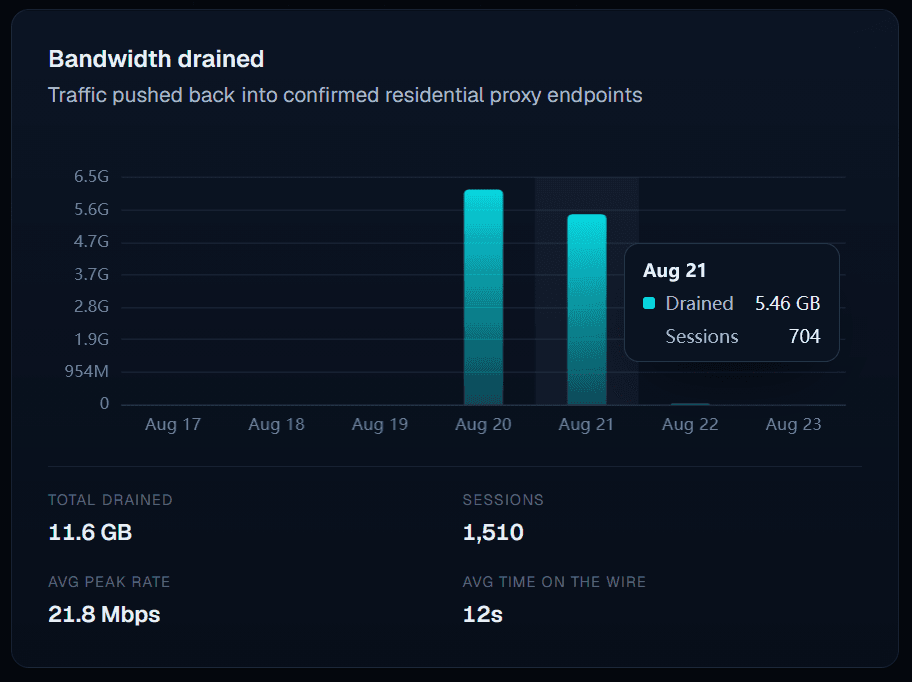
- Aug 17–19: The drain was off.
- Aug 20: We enabled it and sent about 6 GB through confirmed residential proxies.
- Aug 21: Tripwire sent another 5.46 GB across 704 sessions.
- Aug 22: The scraper traffic fell sharply.
- Aug 23: The scraper traffic stopped.
The result
The scraping stopped within two days.
Tripwire drained 11.6 GB across 1,510 confirmed residential proxy connections. The average was 7.9MB per connection, or about 80 times the assumed 100KB page size. The average fell below the 10MB cap because crawlers often left before the transfer finished.
At the rates above, those two days added an estimated $31 to $75 to the operator's bill. The important change is the cost per request, which scales with a larger crawl.
Each drain also occupied the connection for an average of 12 seconds. During that time, the residential device had less capacity for other proxy traffic.
How Tripwire limits false positives
The feature is off by default. It runs only when all three conditions are met:
- You enable it. Each deployment must opt in.
- Tripwire detects a forwarded connection. Its WebSocket test measures a delay caused by the additional hop created by a forwarded connection or TCP-terminating middlebox.
- The IP is a known residential proxy. It must match Layer3 Intel's residential proxy database, which receives more than 500 million unique signals a day.
Neither signal is enough on its own to authorize a bandwidth drain. Requiring both limits draining to Tripwire's highest-confidence residential proxy classification and reduces the risk of draining a legitimate visitor.
Layer3 Intel serves the drain payload. It does not use your origin or CDN bandwidth.
Why it applies only to residential proxies
Tripwire can identify ISP proxies and datacenter proxies, but it does not drain them. Those services often use flat-rate or unmetered bandwidth, so sending extra data would cost us without adding much cost for the proxy operator. The feature works because residential proxy bandwidth is metered.
Turning it on
Add one parameter to the Tripwire snippet:
<script
  src="https://cdn.layer3intel.com/tripwire.min.js?key=YOUR_PUBLIC_KEY&bandwidthDrain=true"
></script>
Bandwidth drain requires the visitor to execute Tripwire's JavaScript, so its effectiveness depends on how your site serves protected content. For stricter enforcement, you can place a Tripwire interstitial at the edge using a Cloudflare Worker or other middleware and require a successful assessment before serving the requested content.
A drained assessment returns its encrypted token after the transfer finishes. If a form waits for that token, run the drain on page load and validate the token already stored for the session. See the bandwidth drain documentation for configuration options and per-call overrides.
Pricing
Tripwire's free plan includes 100,000 assessments a month. Each eligible assessment can send up to 10MB, for a maximum of one terabyte of drain traffic. Layer3 Intel pays to serve that traffic; it does not count against your bandwidth.
What this changes
Bandwidth drain will not stop every scraper but it changes the economics. Defenders have long been able to consume resources on hostile proxy connections with custom engineering. Bandwidth drain turns that tactic into a one-parameter Tripwire feature: in minutes, a site can begin imposing metered bandwidth costs on confirmed residential proxy connections.